Tuesday, May 17, 2016

Unit 7 - Absolute / Comparative Advantage

Unit 7

Absolute and Comparative Advantage

Absolute Advantage
  • Individual- exists when a person can produce more of a certain good/ service than someone else in the same amount of time (or can produce a good using the least amount of resources.)
  •  National-exists when a country can produce more o a good/ service than another county can in the same time period.
Absolute Advantage


Comparative Advantage
  • A person or a nation has a comparative advantage in the production of a product when it can produce the product at a lower domestic opportunity cost than can a trading partner.
Comparative advantage


Examples of Output Problem
  • word per minute
  • miles per gallon
  • tons per acre
  • apple per tree
  • television produced per hour

Examples of Input Problems
  • number of hours to do a job
  • number of acres to feed a horse
  • number of gallon of paint to paint a house

Specialization and Trade
  • Gains from trade are based on comparative advantage, not absolute advantage (who can do what in a certain amount of time)       
Website: https://quizlet.com/27618226/comparative-and-absolute-advantage-flash-cards/
Video: https://www.youtube.com/watch?v=cqGRIqFDo2w


Unit 7- Mechanics of Foreign Exchange

Unit 7

Mechanics of Foreign Exchange

Foreign Exchange (FOREX)
  • The buying and selling of currency*example: in order to purchase souvenirs in France, it is first necessary for Americans to sell their dollars and buy Euros
  • Any transactions that occurs in the balance of payments necessitates foreign exchange
  • Exchange Rate (e) is determined in foreign currency markets

Changes in Exchange Rates
  • Exchange rates (e) are a function of supply and demand for currency- an increase in the supply of a currency- a decrease in supply of a currency will increase the exchange  rate of currency- increase in demand for currency will increase the exchange rate of currency- decrease in demand for a currency will decrease the exchange rate of currency

Appreciation and Depreciation
  •  Appreciation of currency occurs when exchange rate of that currency increases (e^)
  • Depreciation of a currency occurs when the exchange rate of that currency decreases
Example of Appreciation


Exchange Rate Determinants
  • Consumer tastes
  • Relative income
  • Relative price level
  •  Speculation

Exports and Imports
  •  Exchange rate is a determinant of both exports and imports
  •  Appreciation of the dollar causes American goods to be relatively more expensive and foreign goods to be relatively cheaper, thus reducing exports and increasing imports
  • Depreciation of the dollar causes American goods to be relatively cheaper and foreign goods to be relatively more expensive thus increasing exports and reducing imports

Flexible Rates
  • Depends upon supply and demand of that currency vs. other currencies
  • Very sensitive to business cycle / provide options for investments

Fixed Rates

  • Based upon a country's willingness to distribute currency and ability to control amount
Website: https://quizlet.com/12050573/foreign-exchange-market-flash-cards/
Video: https://www.youtube.com/watch?v=dvEI-FGP8tg

Unit 7 - Balance of payments

Unit 7 

Balance of payments

Balance of Payments
  • Measure of money inflows and outflows between the US and the Rest of the World (ROW)
  • Inflows are referred to as credits 
  • Outflows are referred to as debits
  • The balance of payments is divided by 3 accounts
    • 1. Current account
    • 2. Capital/ financial accounts
    • 3. Official reserves accounts


Current Accounts
  • Balance of trade or net exports
  • Net foreign income
  • Net transfers (tend to be unilateral)


Capital/ Financial Accounts
  • The balance of capital ownership
  • Includes the purchase of both real and financial assets
  • Direct investment in the US is a credit to the capital account
  • Direct investment by US Firms/ individuals in foreign country are debits to capital accounts
  • Purchase of foreign financial assets represents a debit to a capital account
  • Purchase of domestic financial assets by foreigners represents a credit to the capital accounts
  •  

Official Reserves
  • Foreign currency holdings of US Federal Reserve System
  • When there is a balance of payments surplus the FED accumulates foreign currency and debits balance of payments
  • When there is a balance of payments deficit FED depletes its reserves of foreign currency and credits balance of payments

Cartoon of Official Reserves


Active VS Passive Official Reserves
  • The US is passive in its use of official reserves
  • Formulas
  • Balance of Trade
  • Good Exports +Goods Imports


Balance of Goods and Services
  • [Goods Exports + Service Exports]   +   [Goods imports + Service Imports]

Example of Goods and Services


Current Account
  • Balance on goods and services + Net Investments and Net Transfers


Capital Account

  • Foreign Purchases + Domestic Purchases

Website: https://quizlet.com/80297677/chapter-38-exchange-rates-the-balance-of-payments-and-trade-deficits-flash-cards/

Video: https://www.youtube.com/watch?v=W0YwGLz50TA


Unit 5 - Extending Analysis of Aggregate Supply

Unit 5

Extending Analysis of Aggregate Supply

Short-Run Aggregate Supply
  • This is the period in which wages (and other input prices) remain fixed as price level increase or decrease

SRAS


Long-Run Aggregate Supply
  • Period of time in which wages have become fully responsive to changes in price level

LRAS


Effects over Short-Run / Long-Run
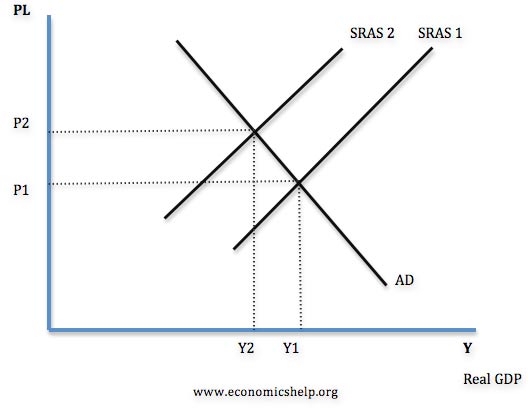
  • In the short-run , price level changes allow for companies to exceed normal out puts and hire more workers because profits are increasing while wages remain constant
  • In the long run, wages will adjust to the price level and previous output level will adjust accordingly.

Equilibrium in the Extended Model
  • The extended model means that both the short run and long run AS curves.
  • The long AS curves is represented with a vertical line at full employment level of real GDP.
  • Demand Pull Inflation in the AS Model
  • Demand pulls (to the right) which causes prices to increase based on increase in aggregate demand.
  • In the short run, demand pull will drive up prices, and increase production
  • In the long run, increase in aggregate demand will eventually return to previous levels.

Cost-Push and the Extended Model
  • Cost-push (to the left) arises from factors that will increase per unit costs such as increase in the price of a key resource.

Dilemma for the Government
  • In an effort to fight cost-push, the government can react in 2 different ways:
    • 1. Action such as spending by the government could begin an inflationary spiral
    • 2. No action however could lead to recession by keeping production and employment levels declining.
Video: https://www.youtube.com/watch?v=Jts4lRsr6xI
Website: https://quizlet.com/11378766/extending-the-analysis-of-aggregate-supply-flash-cards/


Unit 5 Supply Side Economics and Laffer Curve

Unit 5

Supply Side Economics and Laffer Curve

Supply Side Economics
  • Changes in AS and not AD are the main active force in determining the level of inflation, unemployment rates, and economic growth
  • Supply side economists support policies that promote GDP growth by ongoing that high marginal tax rates along with current system of transfer payments such as unemployment of compensation or welfare programs provide disincentives to work, invest, innovate, and undertake entrepreneurial ventures.


Incentives to Save and Invest
  • High marginal tax rates reduce the rewards for savings and investment
  • Consumption might increase but investments depend upon savings
  • Lower marginal tax rates encourage saving and investment

Laffer Curve
  • Theoretical relationship between tax rates and tax revenues
  • As tax rates increase from 0, tax revenues increase from 0 to same maximum level and then decline
    • 3 criticisms of laffer curve
      • 1. Evidence suggests that the impact of tax rates an incentives to work, save and invest are small
      • 2.Tax cuts can also increase demand which can fuel inflation and demand exceed supply
      • 3. Where the economy is actually located on the curve is difficult to determine
Laffer Curve
Video: https://www.youtube.com/watch?v=fIqyCpCPrvU
Website: https://quizlet.com/568555/econ-vocab-words-flash-cards/

Unit 5 Phillip's Curve

Unit 5

Phillip's Curve
  • LRPC exists at the natural rate of unemployment, structural changes in the economy that can affect (un)% will also cause LRPC to shift.
  • Increases in UN will shift LRPC to the right
  • Decreases in UN will shift LRPC to the left

Phillips Curve

Relating Phillips Curve to AS/AD
  • Changes in AS/AD model can also be seen in phillip's curve
LRPC
  • Occurs at natural rate of unemployment
  • Represented by vertical line
  • No trade off between UN and inflation
  • Only shift if LRAS shifts
  • If NRU changes so does LRPC
  • NRU = frictional plus structural plus seasonal Un (4-5%)
  • Major LRPC assumption is that more worker benefits create higher natural rates and a fewer worker benefits create a lower natural rate.

Misery Index
  • Combination of inflation and unemployment in any given year
  • Single digit misery is good

Supply Shocks
  • Rapid and significant in resource cost

Disinflation
  • Reduction in inflation from year to year
  • Can be seen in LRPC

Different types of inflation
  • Deflation 
    • General decline in price
  • Inflation 
    • General rise in price
  • Stagflation 
    • Unemployment and inflation rise/increase at the same time
Video help: https://www.youtube.com/watch?v=zatnIhwmu1c
Website help: https://quizlet.com/20657543/phillips-curve-flash-cards/


Friday, April 8, 2016

Unit 4 Notes

Unit 4

Money

Uses of Money
  • Medium of exchange 
    • Used to barter/trade
  • Unit of Account
    • Establish economic worth in exchange process
  • Store of Value
    • Money holds its value over a period of time while products may not

Money
Types of Money
  • Commodity Money
    •  Gets it value from the type of material its made from
  • Representative Money
    • Paper money that is backed by something tangible
  • Fiat Money
    •  Money which is backed by the word of the government

Characteristics of Money
  • Portable
  • Durable
  • Uniform
  • Scarce
  • Acceptable
  • Divisible

Money Supply
  • M1 Money
    • Currency 
    •  Checkable deposits/demand deposits (checking accounts)
    •  Traveler's check. 
      • 75% of money is liquid 
      • Easy to convert to cash
  • M2 Money
    •  consist of M1 money and saving accounts and deposits held by banks outside of US
      •  Not as liquid as M1 money
  • M3 Money
    • Consist of M2 and certificate of deposits (CDs) 
    • Any money withdrawn a penalty must be paid

Time Value of Money
  • Is a dollar today worth more than a dollar tomorrow? 
    • Yes
  • Why?
    • Opportunity cost 
    • Inflation 
      • Reason for charging and paying interest
  • v= future value of money
  • p= present value of money
  • r= real interest rate (nominal rate - inflation rate) expressed as a decimal
  • n= years
  • k= number of times interest is credited per year

The Simple Interest Formula
  • v= (1+ r)^n x p
  • v= (1+r/k)^nk x p
Time of Money Illustrated
  • Assume that inflation is expected to be 3% and that the nominal interest rate on simple interest savings is 1%
  •  The formula for real interest rate r% = i% - pi%

Demand of Money
  •  An inverse relationship between nominal interest rates and the quantity of money demanded
  • What happens to the quantity demanded of money when interest rates increase? 
    • Quantity demanded falls 
  • What happens to quantity when interest rates decrease?
    • Quantity demanded increases 

Financial Sector
  • Financial Asset 
    • Assets such as stocks and bonds provided expected future benefit 
    • Benefits the owner based upon the issuer of the assets meeting certain obligations
  • Financial Liabilities
    • Liabilities incurred by issuer of a financial asset to stand behind the issued asset
  • Interest Rate
    • The price paid for the use of a financial asset
  • Stock 
    • Financial assets that convey ownership in a company (shareholder)
  • Bonds
    • The promise to pay a certain amount of money and interest in future
What do Banks do?
  • A bank is a financial intermediary 
  • Uses liquid assets (DD) to finance the investments of borrowers
  • Process is known as fractional reserve banking 
    • A system in which depository institutions hold liquid assets less than the amount of deposits
  • Can take form of
    • Currency in bank vaults
    • Bank Reserves- deposits held at the federal reserve
What Banks Do?
  • T-Account (Balance Sheet)
    • Statements of assets and liabilities
  • Asset (Amounts owned)
    • Items to which a bank holds legal claim
    • The uses of funds by financial intermediaries
  • Liabilities(Amounts owed)
    • The legal claims against a bank. 
    • The sources of funds for financial intermediaries

Banks


Functions of FED
  • Uses paper currency
  • Sets reserve requirements and holds reserves of the bank
  • Lends money to bank and charges interest
  • A check clearing service for banks
  • Acts as a personal bank for government
  • Supervises member banks
  • Controls money supply in the economy

Reserve requirement
  • FED requires bank to always have some money readily available to meet consumers' demand for cash
  • The amount, set by the FED is the required reserve ration
  • The required reserve ratios is the percentage of DD that must not be loaned out
  • Typically the required reserve ration is 10%
  • 3 types of multiple deposit expansion?
    • Calculate the initial change in ER
    • Calculate the change in loans in banking system
    • Calculate the change in the money supply
  • Only a small percent of your bank deposit is in the safe. 
  • The rest of your money has been loaned out
  • This is called fractional reserve banking
  • The fed sets the amount that banks must hold
  • The reserve requirement is the percentage of deposits that banks must hold in reserve and loan out
  • When the fed increases the money supply it increases the amount of money held in bank deposits
The Discount Rate
  • The discount rate is the interest rate that the fed charges commercial banks
  • To increase the money supply 
    • FED decrease the discount rate (easy money policy)
  • To decrease the money supply
    • FED increase the discount rate (tight money policy)

Open Market Operations
  • The fed buys/sells government bonds (securities)
  • This is the most important and widely used monetary policy
  • To increase money supply 
    • FED buys bonds
  • To decrease the money supply 
    • FED sells bonds


Federal Fund Rate 
  • This is when banks charge an interest rate to other banks for an overnight or short term loan


Prime Rate
  • The interest rate banks give to most credit worthy customers

Calculating the Money Supply
  • When a customer deposits cash or withdraws cash from their deposit account it has no effect on money supply it only changes:

The Components
  • Direct deposit (DD)
    • Money deposited
  • Reserve Requirement (RR)
    • Money in which must be kept in vault cash
  • Reserve Ratio
    • Percentage of money which must be kept
  • Excess Reserves (ER)
    • Money which can used to increase the money supply
  • Money Multiplier
    • Is 1 divided by the Reserve Ratio
  • Single Bank 
    • The money which can be loaned is ER
  • Banking System
    • the ER x Money Multiplier is the money which can be loaned out
  • FED
    • When the fed buys or sells bonds ER is created

How banks make money
If you still need additional help visit the link below
https://quizlet.com/21749388/chapter-10-the-money-supply-and-the-federal-reserve-system-flash-cards/